Sunday, September 7, 2014
The Savior Anointed
While dining with His disciples, the Savior is anointed
by a woman with a very precious oil. This briefly becomes a point of
disagreement with some of them who feel that she has wasted something that is
valuable, and could have been used for a better purpose. In His response, the Savior implies that the
woman understood what was coming, and that she was there to anoint Him, prior
to his death and burial. What she did
was so selfless and considerate. Who
knows what this small gift must have cost her, or what sacrifices might have
been made that enabled her to serve the Savior at the end of His ministry. I
often wonder what I could give. I
realize that I really don’t have much to give that would be of any value to the
Savior….certainly nothing material would be of much worth. All I really have to give is my heart, my
will, my time, my pride. I can give more
love and effort in my calling, striving harder to understand the youth I teach
in Sunday School, and love them a little more.
I could be a better visiting teacher, and a much better neighbor. The best thing I can give Him is to follow
Him and keep my covenants.

Saturday, August 30, 2014
Preparing for the Second Coming
Watch! In Mark 13, the Savior admonishes us to watch for the day of his coming. He says to watch that we be not deceived, pray for we don't know when he will come, and to watch for those who challenge our testimonies. We are further taught to 'stand in Holy places' and wait for the Lord to come. If we want to be ready for the Lord, we must seek after truth and hold tightly to our testimonies and live the truths that we know.
The Widow's Mite
A certain woman came to the temple to give her offering. She put in two mites. Others around her gave great riches, but she gave all that she had. The beautiful part of this story is how she gave everything in a spirit of sacrifice and love of God. We, like this woman, can give of ourselves in the same spirit of consecration. One of the things we can give is our time. It seems that it is easy for most to give of themselves financially, but it is more difficult to find time. When we seek to serve others in a sprit of love and sacrifice the time that is needed, we truly consecrate what we have to the Lord.
Sunday, August 24, 2014
Christ and the Rich Young Ruler
Commentary on Matthew 19:16-30
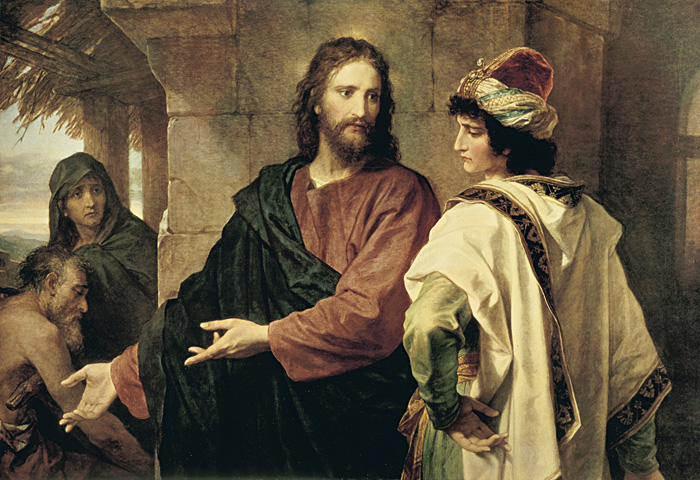
The Savior is approached by
what we understand to be a good and righteous young man. He desires to have the promise of eternal
life, and asks the Master what he needs to do.
The response that is given is that he needs to keep the
commandments. The young man’s response
is “All these things have I kept from my youth up: what lack I yet?” Jesus
answers that he needs to sell all that he has, give the money to the poor, and
follow the Savior. He goes away,
sorrowful, thus choosing to keep his possessions rather than do as the Savior
bid him to. Earlier in His ministry, the
Savior taught that we ought to lay up for ourselves treasures in Heaven, and
that our heart will belong to that which we treasure. It is a hard thing to give up worldly wealth and
possessions for something that is intangible, such as eternal life, if we do
not love God more than we love our things.
As was the case for the rich young ruler, so it is with us. We all have something we can give up to fully
follow the Savior. We know what those
things are, and it is not always the physical things that are required. We can sacrifice our whole hearts, give up
our little sins and transgressions which keep up from following the Savior to
the extent that we should. When we put
the Lord at the front and center of our day, every day, we are blessed the have
the companionship of the Holy Ghost. He
can touch our hearts and inspire us to know what changes we need to make, and
give us the courage to give up the worldly treasures that our hearts are set
upon.
Thursday, August 21, 2014
True Discipleship (Choice 2, Unit 1)
A true disciple of Christ:
Seeks for truth
Focuses on Heavenly treasures, not earthly treasures
Serves his fellowmen
Strives to keep the commandments
Loves the Savior above all else
One of these, in particular, is key to all the others. When we love the Savior first, the rest of
our life falls into its proper place. It
isn’t that lie suddenly becomes easier, but our ability to follow Christ and be
changed by Him increases as our love for Him grows. I find that my love for others, my desire to
learn truth, to seek after Heavenly treasures, to serve, and to be obedient
also increases. True disciples of Jesus
Christ try to keep their life in harmony with the teachings of the gospel. Discipleship
results in good choices which are driven by a deep love and devotion to Jesus
Christ. It really requires all that we are able to give of ourselves, and then
some.
Saturday, August 16, 2014
Unit 2: Become as Little Children
Children
are so precious in the sight of our Savior.
They are meek and submissive, humble and easily instructed. We are all children of our Heavenly Father,
and He desires to have us and love us like children. He wants us to return to Him and He desires
to pour out blessings upon us. We can be
like little children by submitting to the will of the Father. We can lean on the Savior, Jesus Christ, for
our support and rely on His perfect Atonement to compensate for our inadequacies.
Small children are sinless, and though
we are not sinless, we can be made perfect in Christ.

Wednesday, August 13, 2014
The Faith to Walk on Water (Unit 1, Choice 3)
On a particular afternoon, Jesus sent His
disciples out to sea while he remained behind to pray. After a while, He joins them at sea. He walked to them on the water, astonishing
all of them. Peter is permitted to join
the Savior and miraculously also walks on the water. He had tremendous faith. However, Peter sank when he started to pay
attention to the storm that was bustling around him and he became afraid. He cries out to the Lord who immediately
reaches for him. I love the lesson in
this story. We must exercise great faith
in Jesus Christ, and when we do great miracles happen for us. I can’t help but feel that the greatest
miracle happens when we cry out to the Lord and He immediately reaches to save
us. When I experience trials or
difficulties, I, like Peter, can call out to the Savior with pure faith and
trust, and He will be there for me.
Saturday, August 9, 2014
Why the Lord teaches in Parables
The Bible Dictionary teaches that the Savior used parables
to veil the meaning. To those who seek a
deeper understanding of a principle of the gospel, the parable was a way to
teach to their level of understanding.
To those who were not seekers of truth, the parable was a nice story, but
held no real meaning.
One of my favorite parables that the Savior used is the
parable of the treasure. It is so
brief. A man discovers a great treasure in
a field and, in his excitement, sells everything he has so he can then purchase
the land. The Savior compares this
treasure to the kingdom of heaven. Now,
a parable is only as good if we are able to do something with it to make our
lives better. In this case, I would ask
the question, “What am I willing to do that I may receive that great treasure
that is heaven?” This answer is personal
for each of us. For me, I think that
answer is to give up the little things that waste time that could be better
spent on meaningful pursuits.
Relationships, in my opinion, should always come before ‘stuff’ so if I
am too busy tending to the ‘stuff’ in my life, I am often pushing aside the
more important things like playing with my kids or getting to know a
neighbor. This gospel is a gospel for
people. We should be busily making
people the center of what we do.
Tuesday, August 5, 2014
Week 3, Unit 1, Choice 2
Week 3, Unit 1, Choice 2
Study the miracles performed by the Savior, and write about how they influence your faith.
Study the miracles performed by the Savior, and write about how they influence your faith.
|
Reference
|
Miracles of the Lord
|
Who Demonstrated Faith
|
|
Matthew 8:1-4
|
Jesus cleansed and healed
a leper
|
The Leper
|
|
Matthew 8:5-13
|
Jesus heals a the servant
of a centurion
|
The centurion has faith,
as does the servant
|
|
Matthew 8:14-15
|
Jesus heals Peter’s mother in law |
Peter
|
|
Matthew 8:16
|
Jesus heals many who are sick and are afflicted with devils |
All who are healed
|
|
Matthew 8:23-27
|
Jesus calms the storm
while out at sea with his disciples
|
The disciples did not have
faith, so the Savior strengthens their faith through the working of a miracle
|
|
Matthew 8:28-34
|
He casts out 2 devils in 2
men
|
The men show their faith
|
|
Matthew 9:20-22; Mark
5:25-34
|
The woman with an issue of
blood is healed by touching his clothing
|
She shows great faith!
|
|
Matthew 9:27-31
|
Two blind men are healed
and given their sight
|
They both show perfect
faith.
|
|
Mark 2:1-12
|
A boy who is sick with
palsy is both forgiven of his sins, and healed of his infirmity.
|
Those who brought the boy
had faith, and perhaps the boy did as well.
|
My faith has been
strengthened by reading the accounts of the Savior healing people and offering
His forgiveness. What touches me most is
when the Savior forgives people of their sins.
The power to heal is amazing, but the power to forgive even more
so! I have personally felt the redeeming
power of the Atonement as I have forsaken sins and asked for forgiveness. Faith in Jesus Christ makes all the
difference in how I see the world, and in how I make choices each day.
Friday, August 1, 2014
Unit 2, Choice 8: John 2. Water to Wine and Cleansing the Temple
In chapter 2 of St. John, there is a story
of Jesus attending a marriage ceremony. His mother was also in attendance and
takes note that there is no wine for the marriage. She tells Jesus about it. Jesus responds to her, “Woman, what wilt thou
have me to do for thee? That will I do;
for mine hour is not yet come.” I love
that he responded to his mother so quickly, and in turn she faithfully asks the
servants to do whatever he says. His
instruction is for them to fill the waterpots with water. Then he causes them to become wine. This is astonishing for those present. It is
a miracle. The scriptures tell us that
each waterpot is two or three firkins apiece. A firkin is about 9 gallons, so
this was no small thing. This wedding
celebration was quite large, and he was able to perform a miracle that would
provide wine enough for all the people in attendance. I think I always just thought it was a few
cups, just a small token of kindness, when in reality it was a big service to
provide.
In
that passage, the Savior refers to his mother as ‘woman.’ At this time, calling someone ‘woman’ was a
term of respect and endearment and was spoken out of pure love for the mother
who cared for him.
The
Savior makes a visit to the temple, sometime following the marriage. He drives out all those who were seeking for
personal gain within the temple. I think one of the lessons we learn from this
is that the Savior wants us to be clean and attend the temple with a pure heart
and righteous intentions, seeking after the will of our Father. We have to be prepared to worship, and then
take care to treat the temple as a holy place and leave behind the things of
the world.
A Real Live Update!
It has literally been a few years since I gave this blog any attention, and a LOT of life has happened since then. I'm currently using the blog as a way to share some things I am studying in a New Testament class. I thought it might be fun to give a family update though.
We live in Rhode Island.....for now. That is going to change soon. We are awaiting a new assignment with the Navy which will take Shawn back to a ship. We are all gearing up for it. I feel pretty out of practice with flying solo. Hopefully it'll be like riding a bike.....


We live in Rhode Island.....for now. That is going to change soon. We are awaiting a new assignment with the Navy which will take Shawn back to a ship. We are all gearing up for it. I feel pretty out of practice with flying solo. Hopefully it'll be like riding a bike.....
Jack (you haven't met him yet)
Sam (he's the baby on the sidebar--->)
Sarah (you haven't met her either)
One of my favorite spots
My Momma (she's awesome!)
Daddy, Grant, and Nora (hiding behind her hair)
All of us...silly faces included but unintentional
My cute soccer-loving Alex
Mom and Pops
Grant
Nora
A bunch of cuties!
Wednesday, July 30, 2014
Unit 1, Choice 2
Thoughts on John the Baptist
The story of Zacharias and Elizabeth is a very touching
one. Prior to the birth of John,
Zacharias is told that he will have joy and gladness and that there would be
many that would rejoice because of his birth.
This comes to pass when the child is born and is presented and given a
name. Elizabeth rejoiced, and Zacharias
testified that John would fulfill a very sacred and special role of teaching
the gospel and prepare people for the coming of Jesus Christ. His arrival would have been greatly anticipated
by those who read and understood the prophecies concerning the one who would
baptize the Messiah. Mary also
anticipated the special arrival of John the Baptist and rejoiced with her
cousin as they waited for these special sons to be born. The account states that ‘the babe leaped in
her womb’ when she greeted Elizabeth, so even the Savior awaited the special
event with great excitement. John was a
great preacher and prophet who completely fulfilled his special mission of
preparing the way for the Savior of the world.
Wednesday, July 23, 2014
Lesson 6, Unit 2, Choice 1
Choice 1: Jude. “Keep Yourselves in the Love of God”
- Read Jude 1:1–3 and explain in writing how you can multiply mercy, peace, and love. How can you appropriately “contend for the faith”?
We can multiply mercy, peace, and
love by following the example of our Savior.
During His ministry on earth, He sought opportunities to love others by
seeking to understand them, and reaching out to serve. We can do the same in our neighborhoods,
congregations, schools, and communities.
If we desire to ‘contend for the
faith’ we must do so in a respectful manner.
When we find ourselves in conversation with people that disagree with
us, we can assert our beliefs and testify of truth. We should always be careful to have the Holy
Ghost with us. His role is to comfort
and to testify. If He is present, we can
have a better experience in standing up for the truth and invite others to come
unto Christ.
- Read
Jude 1:4–19 and complete the following tasks in writing:
- Using the Bible footnotes and Jeremiah 1:5, identify the doctrine referred to in the phrase “first estate” from Jude 1:6.
The ‘first estate’ refers to those
who chose to follow Jehovah and God in the preexistence.
- Read the institute student manual commentary for Jude 9, “What Do We Know Concerning the Dispute Which Michael the Archangel Had with the Devil About the Body of Moses?” (p. 439); Article of Faith 1:8. How would you explain this odd disputation between Satan and Michael?
It would appear that those
teachings referred to by Jude were not entirely correct. We believe the bible to be true as far as it’s
translation is correct. That is the only
explanation for the strange exchange between Satan and Michael, that some part
of this story is missing.
- What
does Jude 1:14 say about who will accompany the Savior at the Second
Coming?
It says He will come with His
saints; Those who chose to follow Him and keep his commandments.
- Study Jude 1:17, 20–25. Write one or two paragraphs
explaining how we can avoid the evils that often come from false
teachers.
We
avoid the evils that come from false teachings by remembering the covenants
that we have made, specifically the baptismal covenant to ‘always remember Him.’ When we remember our Savior, Jesus Christ, we
are blessed to be able to identify teachings that are true and recognize false
doctrine. This is important because
listening to false teachings will lead us away and may cause us to sin.
Tuesday, July 22, 2014
Lesson 6, Unit 1, Question 5
Choice 5: 2 John. Abide “in the Doctrine of Christ”
- Read 2 John 1:7 and the institute student
manual commentary for 2 John 7, “For Many Deceivers Are Entered into the
World” (p. 437). Summarize in one or two paragraphs the false doctrine
John warned against, where it came from, and what effect it would have if
it were believed.
- Read 2
John 1:8–13. Write one or two sentences explaining what counsel John gave
that could help avoid this and other false doctrines generally.
John taught us that ‘many deceivers are
entered into the world, who confess not that Jesus Christ is come in the flesh.’
To take this a little further, we understand such deception to openly argue
that there is no Christ, and that there has been no Atonement made nor
resurrection for the saving of the body and soul. There are many who seek to push such doctrine
in our day. Many people who were once
believers in Jesus Christ are led away subtly and carefully by half-truths and
then full lies until they no longer believe in and accept Jesus Christ as the
Savior of the world.
We need to be wary of such false
doctrine. We live in a time where it is
preached loudly, softly, harshly, and subtly, and when it is very difficult to
distinguish between truth and lie. The
only way to be safe from such trickery is to watch ourselves in the things that
we do and the people we choose to associate with. We much seek after, the teach, the true
doctrine of Christ in our homes. We must
repent of our sins and accept Jesus Christ as our Savior. And we must keep the companionship of the
Holy Ghost always, that we may not be caught off-guard and fall into Satan’s
trap.
Friday, July 18, 2014
Unit 2, Choice 4 (Lesson 5)
Choice 4: 1 Peter 1–4. The Trial of
Our Faith Is More Precious than Gold
Read 1 Peter 1:1–9; 2:12, 15, 20–25;
3:11–16; 4:12–19. Write two to three paragraphs using the principles of these
verses to explain to someone who says, “Life isn’t fair. Why do I have to have
so many trials? I’m tired of being ridiculed by those who do not keep the
commandments.”
Dear Friend,
I’m
sorry you feel that life isn’t fair. The
truth is, it isn’t fair. We don’t always
get to have the popsicle color we want, money runs out, jobs are lost, we all
get sick, loved ones die, and these things happen whether or not we keep the
commandments and stay true to the gospel.
The good news is that the perfect Atonement of Jesus Christ is what
makes life fair! When we choose to endure
our trials with patience and faith, we are strengthened by Him.
Peter
teaches us that if we are doing our best to endure well and keep the
commandments, that we will have a clean conscience. We will know that our works are pleasing to
the Lord. If we find ourselves ridiculed
or harassed because we choose to do good, even in those moments where we seem
to have been abandoned, we can take courage that through the suffering and
sacrifice of Jesus Christ, our trials have not been for nothing. If we were to choose to abandon our faith and
do evil things, we would not have the assurance that comes with knowing that
the Lord is on our side.
Do not
be discouraged when it seems that life has treated you unfairly. Allow those difficult experiences to teach
you patience and humility. You will find
a sweet peace that will come in humbly turning to the Lord in your
afflictions. Your good works will
certainly stand as a witness of your faith when you return to meet our Father.
~Michelle
Tuesday, July 15, 2014
Unit 1, Choice 3
Choice Three: Hebrews 13. Works of Righteousness
Paul concluded his epistle to the Hebrews with some brief
teachings and statements of counsel. Read Hebrews 13 and find statements about
the following questions:
• How should we treat strangers and
those “in bonds”?
Paul counseled us to ‘let brotherly
love continue.’ We should have as much
compassion, love, and kindness toward those who are imprisoned as we do for
those who are not.
• How is marriage looked upon?
Marriage is honorable, always. Sexual relationships outside of marriage are
never permissible to the Lord.
• What warnings are given about
covetousness?
We should refrain from expressing
our feelings of jealousy in our conversations, and should likewise simply not
be jealous of others. When we are
content, there is no room in our hearts for desiring wwhat others have. We are so much happier. There are some dangers in coveting that go
beyond simple feelings of jealousy.
These simple feelings can lead to regrettable actions such as debt or
worse, stealing. President Hinckley said
this, ”Debt can be a terrible thing. It is so easy to incur and so difficult to
repay. Borrowed money is had only at a price, and that price can be burdensome.
Bankruptcy generally is the bitter fruit of debt. It is a tragic fulfillment of
a simple process of borrowing more than one can repay.” When we learn to be content, we keep ourselves
free from the bondage of greed and debt.
• What is “the same yesterday, and
to day, and for ever”?
Jesus Christ is the same “yesterday,
and to day, and for ever.” His gospel
never changes, His Atonement is perfect and eternal.
• How are we sanctified?
We are sanctified through the blood
of Jesus Christ. His was the sacrifice
to end all sacrifice. Through Him, we
can be cleansed and justified from our sins.
• How do we respond to those who
rule over us?
We should obey those who rule over
us. We submit ourselves to them, for the
watch over our souls and have responsibility over us.
• Who did Paul ask the people to
pray for?
He asked the people to pray for
their leaders. What a burden they carry.
We too must pray for our leaders that they may have the strength needed to do
the Lord’s work.
Saturday, July 12, 2014
Unit 2, Choice 1
Hebrews 5-7. Jesus Christ is Greater than
Melchizedek
- Read Hebrews 5:4; Numbers
27:18, 23; Doctrine and Covenants 42:11; Articles of Faith 1:5. From these
verses describe in writing the Lord’s approved pattern for how someone
comes to be a priesthood leader. How do we know who has authority in the
Church today?
Priesthood leaders are called of
God and set apart by the laying on of hands. The person who calls and sets them
apart must have the proper authority to do so.
No person can simply take a priesthood leadership position on their own
without each of the proper elements in place.
2.
Read Hebrews 5:7-8; Joseph Smith Translation, Genesis 14:25-40 and the
institute student manual commentary for Hebrews 5:7-8, “Does the Phrase ‘Though
He Were a Son’ Apply to Melchezidek, to Christ, or to Both?” (p. 384). Write
the answers to the following questions:
o
Why was Melchizedek considered a great high priest?
He was a very
righteous man who established and maintained peace, and his people also sought
after righteousness. He was a living
foreshadow typifying of Jesus Christ.
o
List a few of the miracles he performed according to Joseph Smith Translation,
Genesis 14:25-40.
Verse 30-31
state that he had power to “break up mountains, to divide the seas, to dry up
waters, to [defy] armies, to divide the earth, to break every band, to stand in
the presence of God.” It seems that the
power to perform these miracles is available to everyone who is ordained after
the same order as Melchizedek.
o
What Old Testament prophet did Melchizedek bless?
Abram, or
Abraham.
o
Read Doctrine and Covenants 107:2-4 and explain why we call the greater
priesthood the Melchizedek Priesthood.
This was to
avoid vainly and repetitiously using the name of God.
3.
Read Hebrews 6:1-3. Then write answers to the following questions:
o
What important doctrinal correction did Joseph Smith make in Hebrews 6:1? (See
footnote a).
He noted that
the verse should read “Therefore not
leaving the principles of the doctrine of Christ”
o
Why is it important that a person not leave behind faith, repentance, baptism,
and the gift of the Holy Ghost?
Faith,
repentance, baptism, and the gift of the Holy Ghost are the very foundation of
the doctrine of Jesus Christ. Without
these things, we lose the very essence of the gospel of salvation, which is to
allow the children of God to repent and return to Him through the Atonement of
Jesus Christ.
4.
Read Hebrews 6:4-6; Alma 24:30; Doctrine and Covenants 76:31-38 and the
institute student manual commentary for Hebrews 6:4-6, “What Must People Do in
Order to ‘Crucify To Themselves the Son of God Afresh, and Put Him to an Open
Shame’?” (p.385). According to Matthew 12:31, how serious is the sin described
in Hebrews 6:4-6? Write what a person must do to become a son of perdition and
what the eventual punishment will be.
This is the most
serious of sins: to deny the Holy Ghost after knowing of a surety and having a
personal witness that Jesus is the Christ, and of the plan of salvation. They will suffer for their blatant sins
against God, and will not be redeemed.
(Personal thought here….)I wonder if it is because they no longer have faith in the atonement of Jesus
Christ. In order for the atonement to
have place in us we must first have faith, and then repent. Based on the scriptural evidence, it would
seem that it is only open rebellion that creates a son of perdition. I think the path that is taken for those
people begins at least with a lack of true faith, and perhaps ends that way as
well.
5. Read
the institute student manual commentary for Hebrews 7:3, “Was Melchizedek
‘Without Father, Without Mother, Without Descent’?” (p. 385). Identify in
writing who Hebrews 7:3 is speaking of.
The right to the
priesthood is not something that is passed down from father to son (although it
can be conferred on a son by a father, or on a father by a son), rather it
follows the proper order through righteousness.
This verse is specifically referring to the priesthood, not to an
individual.
Wednesday, July 9, 2014
Lesson 4, Student Choice 1
Philippians 1–4. Find Solutions in the
Scriptures to Life’s Challenges
·
People sometimes argue and complain over petty matters in church meetings or
throughout the week (see Philippians 2:1–8, 14–15).
This is certainly something that happens
frequently, I think. It is no surprise
since the world is made up of people with many different personalities and
experiences. Paul’s counsel is to ‘do
all things without murmurings and disputings: That ye may be blameless and
harmless, the sons of God.’ This is
important because it isn’t the way that we feel about things that matters,
rather it is the way we choose to respond to difficult situations that
matters. Whether we really like each
other or not, we who claim to be followers of Jesus Christ have a sacred duty
to follow his example in treating others better than ourselves.
·
Many youth feel that their parents’ testimony is sufficient for them. Since
they have good parents, they rely on them for all their spiritual strength (see
Philippians 2:12–15 and institute student manual commentary for Philippians
2:12, “Work out Your Own Salvation with Fear and Trembling” [pp. 361–62]).
I believe that, for a time, it is perfectly
okay for young people to rely on the testimony of their parents (or teachers,
leaders, friends) until they are strong enough to rely on their own. Even Elder Holland said in a recent general
conference that it was okay to rely on his testimony until we have our own. That said, it is important for each
individual to become spiritually self-reliant.
Salvation is really an individual matter so it is up to the individual
to come to know Christ and accept his Atonement. I have to include this fantastic quote from this
student manual, because President McKay explains it so eloquently: “To work out
one’s salvation is not to sit idly by dreaming and yearning for God
miraculously to thrust bounteous blessings into our laps. It is to perform
daily, hourly, momentarily, if necessary, the immediate task or duty at hand,
and to continue happily in such performance as the years come and go, leaving
the fruits of such labors either for self or for others to be bestowed as a
just and beneficent Father may determine.” (David O. McKay in CR, Apr. 1957, p.
7.)
·
An investigator is considering joining the Church, but his family will no
longer associate with him if he does (see Philippians 3:7–16; 4:13).
This is a tough place to be in. I have no personal experience with this. However, I believe, and Paul also taught,
that when we give up everything to know Jesus Christ, our friends and family
too if necessary, then He will make up the difference. When we walk with the Savior, even if that
path is sometimes a little lonely, we are never really alone.
·
How is this writing assignment an example of the principle taught in 2 Nephi
32:3?
If we ever have
a question about how to live the gospel, we can always find the answers we seek
in the scriptures. We may not always
find the exact situation as lived by someone else, but through gospel study,
through feasting on the words of Jesus Christ, we can receive the needed
revelation to solve the problems that we may face.
Thursday, July 3, 2014
Week 4, Unit 2, Choice 1
Unit
2, Choice 1: Romans 12-16. Live as Saints Should Live
Here
are some of my thoughts about Paul’s teachings to the Romans.
If
we desire to have salvation in Christ, we must continually work
righteousness. We do this by keeping the
commandments, honoring our covenants, and enduring the trials we must
bear. We do these things in faith and
then we can have the gift of eternal life with God. Paul offers some
suggestions of ways that we should live that we may attain this gift:
Keep ourselves unspotted
from the world
Cleave unto things that are
good
Give to those who stand in
need
Be united and not prideful
Overcome evil with good
Be subject unto God-be
humble
Love one another
Keep all of the commandments
These are very basic standards that
are easy to live by, and contribute to a wholesome life. In addition to those things, Paul teaches
that we should not judge each other. God
loves all of us, and though we may see the world differently, we should not
contend with our friends and neighbors, but should seek to keep peace with them. We should not judge one another, for we all
live and die to God and will stand to be judge of Him. Doctrine and Covenants 38:25-27 gives us even
more insight on why we should not judge.
In essence it teaches what the world calls ‘the golden rule’ which is,
of course where we treat others the way we want to be treated. We are courteous, respectful, and above all,
loving.
Paul
refers to the church members as saints.
I think he sees them as faithful individuals who should be united in
their actions through their belief in Jesus Christ. We also refer to ourselves as latter-day
saints, and strive to be true followers of Christ, “living as saints should
live” through the honoring and keeping of sacred commandments and covenants.
Monday, June 30, 2014
Student Choice Lesson 3, Unit 1
Student Choice Week 4, Choice 3
Baptism: Romans 6
Prior to being baptized, all must
repent of their sins. Paul describes
this beautifully in Romans 6:12: “…reckon ye also yourselves to be dead indeed
unto sin, but alive unto God through Jesus Christ our Lord.” This description sums up the symbolism in the
previous scriptures, where Jesus Christ’s death symbolizes the death of, or
giving up of our sins, and gaining a new life in Him. Baptism must be done by immersion to
symbolize a complete change in ourselves, through this symbolic death, followed
by a rising up out of the water and a new and clean individual. Baptism by sprinkling does not carry with it
the same meaning, nor change and commitment to leave behind the sins of the
past. Paul teaches that we are to yield
ourselves to God, and not to sin, continually repenting through the
Savior. In the book of Mosiah, King Benjamin
teaches that “the natural man is an enemy to God.” When we repent and are baptized, this is what
we are actually giving up: the easiness of following our basest desires and
instincts for a life of self-mastery and submission to God’s will. This is not the easier choice, to be
sure. Rather, it is the choice which
will provide lasting happiness and inner peace.
“No Man Can Serve Two Masters”
We cannot live in sin and expect to
receive the grace of God. A choice must
be made to sin or to not sin; Also, whether or not to repent when we have
sinned. The choices we make are the very
things that indicate whom we prefer to serve.
If we are subjects to sin, then we are the servant of the tempter and
his angels. We become imprisoned by our
choice to follow Satan and often have difficulty abandoning wicked
practices. When we choose the abandon those
sins, we become free to really live.
When we are willing to give up something we might really like in order
to become a disciple of Christ, then we know we are a true servant and follower
of Him. Christ is the only true source
of freedom. Through Him we have life
free from oppression caused by sin.
Through Him we have happiness and joy.
This is liberty: To live and love
after the manner of happiness through Jesus Christ, the life and light of the
world.
Subscribe to:
Posts (Atom)

my office...


